
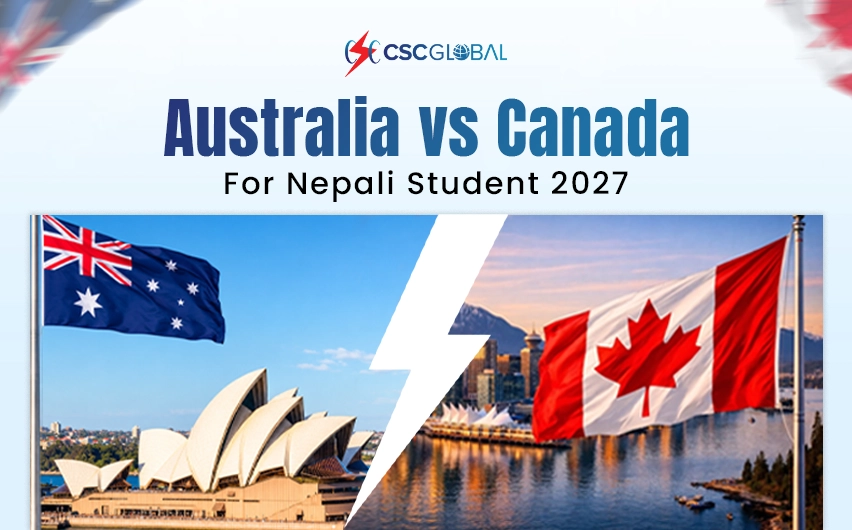

Australia vs Canada is the biggest question for Nepali students planning a 2027 intake. Both countries have tightened their rules, but in different ways. Australia’s changes on 2 October 2026 hit students with families and those already in Australia hardest. Canada limits the number of study permits each year and allows spouses to work only for certain programs.
This guide compares the two on visa chances, costs, family rules, work rights and life after graduation, so you can choose the better fit for your profile.
Australia vs Canada at a Glance
| Australia | Canada | |
|---|---|---|
| Visa fee | AUD 2,500 (about NPR 2.7 lakh) | CAD 235 with biometrics (about NPR 25,000) |
| Living-cost funds to show | AUD 29,710 (about NPR 31.8 lakh) | CAD 23,448 (about NPR 25.3 lakh) |
| Recent approval rate | 36% for Nepali applicants (Jan–May 2026) | 31% overall; 53% at universities (early 2025) |
| Spouse can come and work | Rarely (PhD and a few other groups only) | Yes, for master’s of 16+ months, PhD and some professional degrees |
| Work while studying | 48 hours per fortnight | 24 hours per week |
| Post-study work | 485 visa, 2–3 years, age 35 or under | PGWP, up to 3 years, no age limit |
Sources for each figure are in the sections below.
Visa Chances and Student Caps
Both countries now approve far fewer Nepali students than before, so a strong application matters in either case.
| Australia | Canada | |
|---|---|---|
| Limit on new students | 295,000 in 2027 (The PIE News) | 155,000 in 2026 and 150,000 in 2027 (CIC News) |
| Latest approval data | 36% of Nepali applicants approved, January–May 2026 (Kathmandu Post) | 31% of all new study permit applications approved in early 2025: 53% at universities, 28% at colleges (The PIE News) |
| Extra checks | Nepal is at Evidence Level 3, the highest-risk category | Most applicants need a provincial attestation letter (PAL) from the province |
In Canada, master’s and PhD students at public institutions no longer need a PAL from 1 January 2026, so they sit outside the provincial limits (IRCC). In both countries, university programs have a much better track record than college or vocational ones.
Australia vs Canada: Which Is Cheaper?
Canada is usually cheaper for a master’s degree. It asks for less living-cost money, and its visa fee is about a tenth of Australia’s.
| Cost | Australia | Canada |
|---|---|---|
| Living-cost funds to show (1 year, single student) | AUD 29,710 (about NPR 31.8 lakh) (One Planet Migration) | CAD 23,448 (about NPR 25.3 lakh), from 1 September 2026 (CIC News) |
| Visa fee | AUD 2,500 (about NPR 2.7 lakh), not refunded if refused (The PIE News) | CAD 235 including biometrics (about NPR 25,000) (ApplyBoard) |
| Typical postgraduate tuition, per year | AUD 22,000–50,000 (about NPR 23.5–53.5 lakh) (WIDEN) | About CAD 24,700 on average (about NPR 26.7 lakh) (ApplyBoard) |
Undergraduate study in Canada averages about CAD 42,000 a year (about NPR 45.4 lakh), so the gap narrows for bachelor’s degrees. Both countries also expect you to show first-year tuition and travel costs. NPR figures use about NPR 107 per AUD and NPR 108 per CAD (October 2026); check the latest Nepal Rastra Bank rate.
Can You Take Your Spouse?
For married students, this is now the biggest difference. Canada still lets many master’s students bring a spouse who can work; Australia mostly does not.
| Australia (from 2 October 2026) | Canada (from 21 January 2025) | |
|---|---|---|
| Who can bring a spouse | Only PhD students, DFAT or Defence-sponsored students, foreign government scholarship holders and eligible Pacific or ASEAN students. Nepal does not qualify. (AHC Lawyers) | A spouse can get an open work permit if you study a master’s of 16 months or longer, a PhD, or a professional degree such as nursing, engineering, law, medicine, pharmacy or education (IRCC) |
| Adding a spouse later | Not allowed | Possible, if your program qualifies |
In Canada, a spouse can usually work for as long as your study permit is valid. Diplomas, short master’s programs and most bachelor’s degrees do not qualify (professional bachelor’s degrees in nursing, education and engineering are exceptions), so choose a program of at least 16 months if your spouse needs to work.
Work Rights and Life After Graduation
Work rights while studying are similar. After graduation, Canada gives master’s graduates a longer work permit with no age limit.
| Australia | Canada | |
|---|---|---|
| Work while studying | 48 hours per fortnight in term, unlimited in breaks (UNE) | 24 hours per week in term, unlimited in scheduled breaks (IRCC) |
| Post-study work visa | Temporary Graduate visa (485) | Post-Graduation Work Permit (PGWP) |
| How long | Usually 2–3 years, depending on your qualification (IELTS Australia) | Up to 3 years; master’s graduates can get 3 years even from a program shorter than 2 years (IRCC) |
| Age limit | 35 or younger (under 50 for research master’s or PhD) | None |
| English needed | IELTS 6.5 overall, 5.5 in each band | CLB 7 for university graduates, CLB 5 for college graduates (Careers360) |
Permanent residence: Canada’s 2026–2028 plan focuses on moving people already in Canada with skills and experience to PR. It raises provincial nominee targets by 66% in 2026, and its Canadian Experience Class needs one year of Canadian work experience (CIC News). Neither country guarantees PR after study, so choose a course for the career it leads to.
Already in Australia? Moving to Canada to Study
Many Nepali students in Australia, especially 485 and visitor visa holders, can no longer apply for a new Australian student visa onshore. Canada is an option you can apply for without going back to Nepal first. You apply online and give biometrics at a visa application centre in the country you apply from (SFU).
You will need:
- An offer letter from a Canadian designated learning institution
- A provincial attestation letter (PAL), unless you study a master’s or PhD at a public institution
- Proof of funds: first-year tuition plus CAD 23,448 for living costs
- An English test score and your academic documents, including your Australian transcripts
Explain your Australian study and work history clearly in your study plan, especially if you are changing field or moving to a lower level. For questions about your current Australian visa, speak to a registered migration agent in Australia.
Australia vs Canada: Which Should You Choose?
The better country depends on your situation:
| Your situation | Better fit | Why |
|---|---|---|
| Married, and your spouse needs to work | Canada | Spouses of master’s (16+ months), PhD and some professional-degree students can get an open work permit. |
| Already in Australia on a 485 or visitor visa | Canada | You can apply from Australia; a new Australian student visa needs an offshore application. |
| Master’s student on a tighter budget | Canada | Lower funds to show and a much lower visa fee. |
| Over 35 and planning to work after study | Canada | The PGWP has no age limit. |
| Strong academic record and a clear course–career link | Either | Both still approve well-prepared university applicants. |
| Planning a diploma or vocational course | Think twice in both | Australian VET and Canadian college applications have the lowest approval rates. Consider a university program. |
If none of these apply, compare the specific course, city and total cost in both countries before you decide.
How CSC Global Helps You Decide
At CSC Global (formerly Canadian Study Center), we counsel students for both Australia and Canada, so we compare your options honestly. With offices across Nepal and a branch in Canada, we support you before you apply and after you arrive. We help with course choice, spouse-friendly programs, financial documents, IELTS and PTE preparation, and visa applications.
Visit our branches in Kathmandu, Lalitpur, Chitwan or Butwal, or book a free counselling session to compare Australia and Canada for your profile.
FAQ Section
Australia vs Canada: which is better for Nepali students in 2027?
It depends on your profile. Canada suits married students, master’s students on a budget and applicants over 35. Australia still works for strong university applicants with a clear course–career link.
Which is cheaper,Australia vs Canada ?
Canada, for most master’s students. You show CAD 23,448 for living costs instead of AUD 29,710, and the visa fee is CAD 235 instead of AUD 2,500.
Can I take my spouse to Canada on a student visa from Nepal?
Yes, if you study a master’s of 16 months or longer, a PhD or an eligible professional degree. Your spouse can then apply for an open work permit.
Can I move from Australia to Canada to study?
Yes. You can apply online from Australia and give biometrics there. You need a PAL unless you study a master’s or PhD at a public institution.
Which country has a higher visa success rate for Nepali students?
Both are low. Australia approved 36% of Nepali applicants from January to May 2026. Canada approved 31% of all new applicants in early 2025, but 53% at universities.