
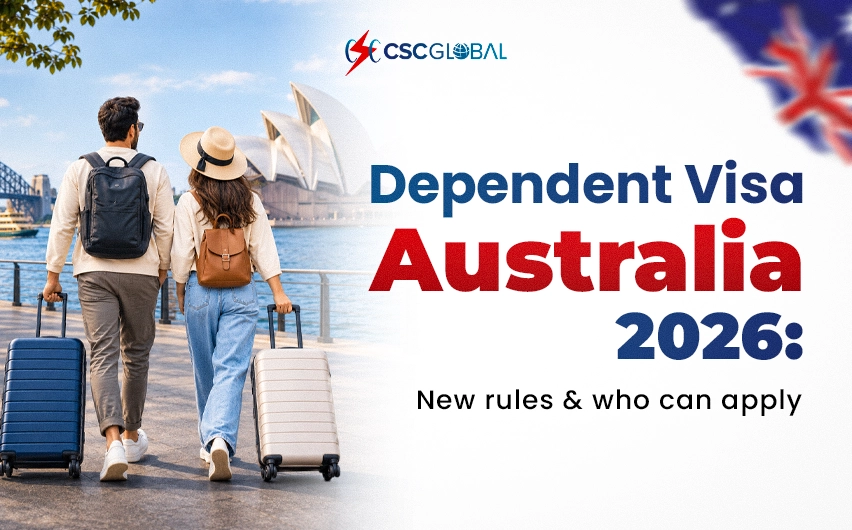

Up until now, you could apply for a dependent visa in Australia relatively freely. That is no longer the case. The 2 October 2026 update made the dependent visa requirements for Student visa applicants much stricter, that means most students can no longer include a spouse or children unless they qualify for an exemption. Family members also cannot be added after the Student visa has been granted.
This blog will explain who is eligible for a dependent visa in Australia, what happens to existing visa holders, and what options are available if you cannot bring your family to Australia. This guide covers the requirements for a dependent visa in Australia, who is exempt, and what to do if you aren’t eligible.
Last checked against official sources: 13 November 2026.
What Is a Dependent Visa in Australia?
The term “Dependent Visa” is not the official term. It is commonly used by students to refer to secondary applicants whose visa depends on the main applicant. Secondary applicants must be included in a Student visa (subclass 500) application.
If you are the main applicant, your dependants (secondary applicants) can be:
- Your spouse or de facto partner
- Your dependent children
Parents and siblings, however, fall under other visa categories like Visitor (subclass 600).
What Changed on 2 October 2026?
The main changes under the new Student visa application rules that started on 2 October 2026 are:
- You cannot include your partner or children as secondary applicants unless you qualify for an exemption. This also applies to future Student visa applications.
- Family members can no longer be added after the Student visa is granted. There are no exemptions to this rule.
- If you applied before 2 October 2026, your application will be assessed under the old rules.
Existing Student visas will not be cancelled because of these changes. You can get more information in the official Home Affairs fact sheet and on the Home Affairs page on changes to Student visa application rules. If you are also weighing up how this affects your study plans, see our latest guide on the Australia 2026 student cap increase.
Australia Dependent Visa Requirements: Who Can Still Apply?
As per the Subclass 500 eligibility requirements, you may include your children or spouse as secondary applicants if you are:
- A PhD student.
- Sponsored by the Department of Foreign Affairs and Trade (DFAT) or Defence.
- Receiving a foreign government scholarship.
- An eligible student from a Pacific country or an ASEAN member country.
Dependent Visa Australia for Nepali Students
If you are a Nepali student applying for a new Student visa, the first three are the relevant exemption categories for you. This is because Nepal is neither a Pacific country nor an ASEAN member country.
Generally, you cannot bring your partner or children if you are planning to attend a bachelor’s degree or a coursework master’s degree, unless you qualify for one of the exemptions. If you are still deciding on a destination, our comparison of Australia vs Canada for Nepali students can help you weigh your options.
What About the Families Already in Australia?
Your family might still be eligible under transitional arrangements if they are already included in your current Student visa.
According to Home Affairs, you may be able to include existing family members in a subsequent Student visa application in the following situations:
- Your family members are already included in your current Student visa, and you apply for another Student visa while in Australia.
- You need up to 12 more months to complete the main course covered by your current Student visa.
- You need to lodge another Student visa application because your education provider has defaulted.
For the second and third situations, you may be able to include family members who were already included in your current Student visa even if you apply from outside Australia.
To know about the conditions for children born in Australia, you can read the Home Affairs information on newborn children.
Note: These arrangements do not apply to new applicants who have not already included their family members in their current Student visa.
How to Apply for a Dependent Visa in Australia
If you qualify for a dependent visa, you can follow these steps to apply:
- Be sure you qualify and fall into one of the exemption categories.
- Prepare your documents, such as passports, proof of relationship, financial documents and other required documents.
- Apply together. When the application is lodged, you and your family members included in the application must be in the same location.
- Arrange health cover. Check the Overseas Student Health Cover (OSHC) rules for everyone on the application. Our OSHC requirements guide for Nepali students can help.
- Wait for the decision. Wait until the results are in before booking flights.
Dependent Visa Australia: Documents Required
While exact document requirements depend on your case, these are some of the most common ones:
- Valid passports for every applicant
- Marriage certificate or birth certificates to prove your relationship
- Your student enrolment details
- Proof that you have enough money for the whole family
- Suitable health cover
- Certified English translations of any documents in other languages
Even small mistakes can cause delays in processing, so ensure every detail matches across all documents. You can check the full checklist for your situation on the official Student visa (subclass 500) page.
Dependent Visa vs Visitor Visa
If your children or spouse are not eligible for a dependent visa, a Visitor visa might be an option.
| Feature | Dependent (Secondary Applicant) | Visitor Visa (Subclass 600) |
| Purpose | Accompany the student | Visit family or travel |
| Length of stay | Linked to the Student visa | Depends on the visa grant; may be up to 12 months |
| Linked to Student visa | Yes | No |
| Who can apply now? | Family of students who qualify for an exemption | Anyone who meets Visitor visa requirements |
However, these visas serve different purposes. As per Home Affairs, a Visitor visa is for tourism or visiting family and friends. It is a temporary visa and is not intended for someone to live in Australia throughout your entire course.
What If Your Family Cannot Come With You?
If you are not eligible for an exemption, you may still consider these alternative pathways:
- Plan visits. Your spouse or dependent children may apply for a Visitor visa if they satisfy all criteria. Be sure to review the specific visa requirements for family members.
- Compare other countries.If relocating together is essential, explore study destinations offering clearer dependent pathways. Our guide to Canada dependent visa requirements provides a helpful starting point.
- Get expert advice. For complex circumstances, consult a registered migration agent to explore your options.
Mistakes to Avoid
- Relying on outdated resources that detail regulations prior to October 2026
- Assuming you can add your partner or children after visa approval
- Using a Visitor visa for long-term residency purposes
- Providing conflicting details across your application documents
- Underestimating the financial support required for your dependants
Conclusion
Following the policy changes on 2 October 2026, securing a dependent visa has become significantly more restrictive. Generally, student visa holders cannot bring family members unless they meet specific exemption criteria. However, existing visa holders with included dependents may qualify under transitional rules.
If you don’t qualify for an exemption, your family can still visit on a Visitor visa (subclass 600), but not as a way to live in Australia for the whole course. Check your exemption eligibility first, then speak to a registered migration agent if your case is complex.
For additional assistance, check our guide on post-study work rights in Australia, explore the best programs in Australia for PR opportunities and read our Australia visa success rate overview.
Frequently Asked Questions
1. Can I bring my spouse and children to Australia on a student visa in 2026?
You can only include dependents if you fall under an eligible exemption. Under the updated framework effective 2 October 2026, standard Student visa applicants cannot bring their partner or children.
2. Can I add my family after my student visa is granted?
No. Home Affairs regulations strictly prevent adding family members as secondary applicants once your visa is issued.
3. Can Nepali students bring dependants to Australia?
Nepali applicants are eligible only if they meet specific exemption criteria, such as pursuing a PhD or receiving approved government sponsorship.
4. What happens if I applied before 2 October 2026?
Applications submitted prior to 2 October 2026 will be evaluated under the previous rules, allowing included dependents to be processed accordingly. Study Australia’s October 2026 update explains this in more detail.
5. Can my family visit me in Australia?
Yes. Family members can apply separately for a Visitor visa (subclass 600) provided they meet general eligibility requirements. Approved stay durations depend on the individual grant.
6. What are the requirements for a dependent visa in Australia?
You must qualify for an exemption (PhD, DFAT or Defence sponsorship, a foreign government scholarship, or Pacific/ASEAN eligibility) and apply together with your family. They cannot be added after the visa is granted.